Author: Lannick Dinard

  • The Urban Duck

    The Urban Duck

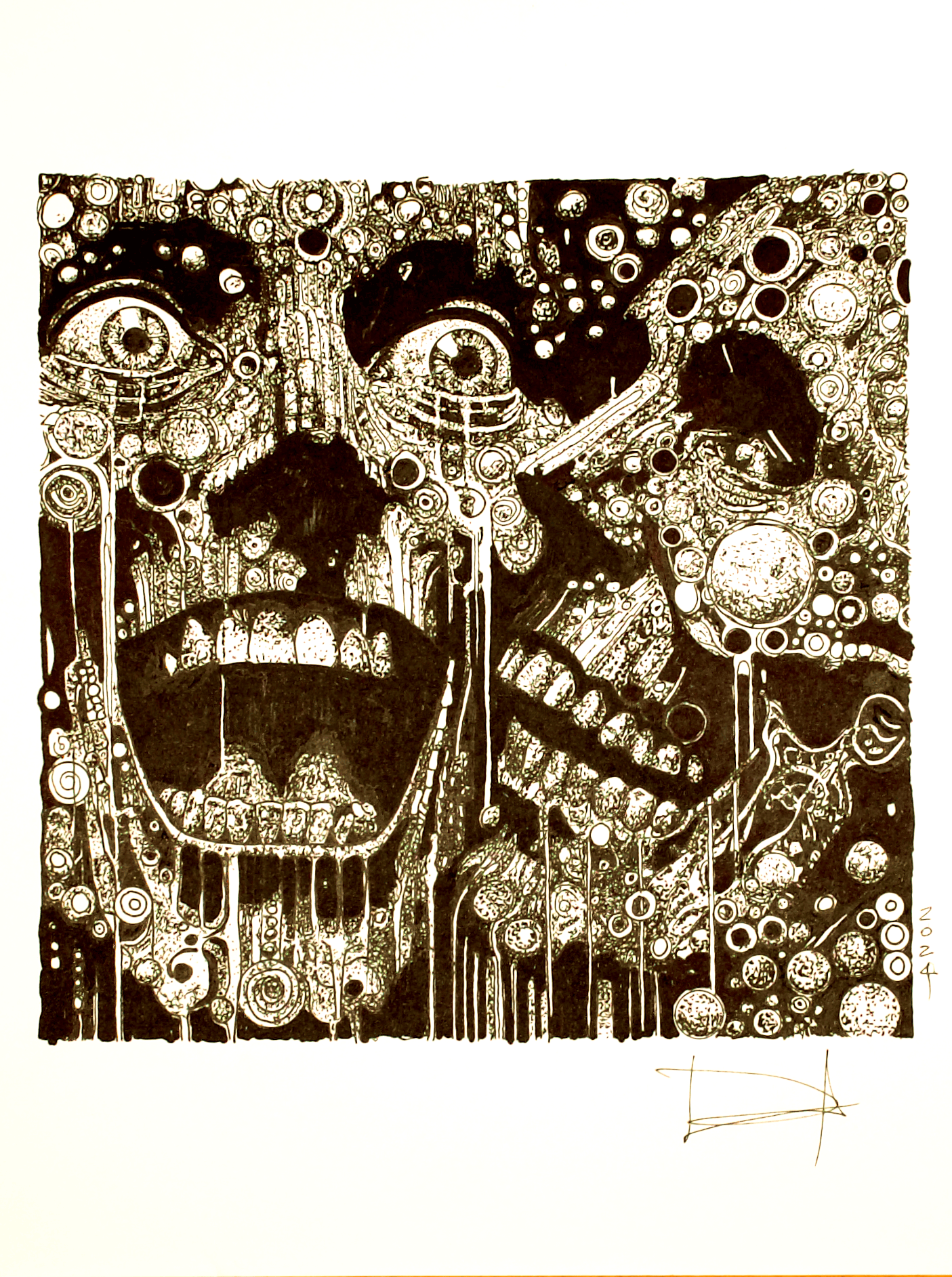
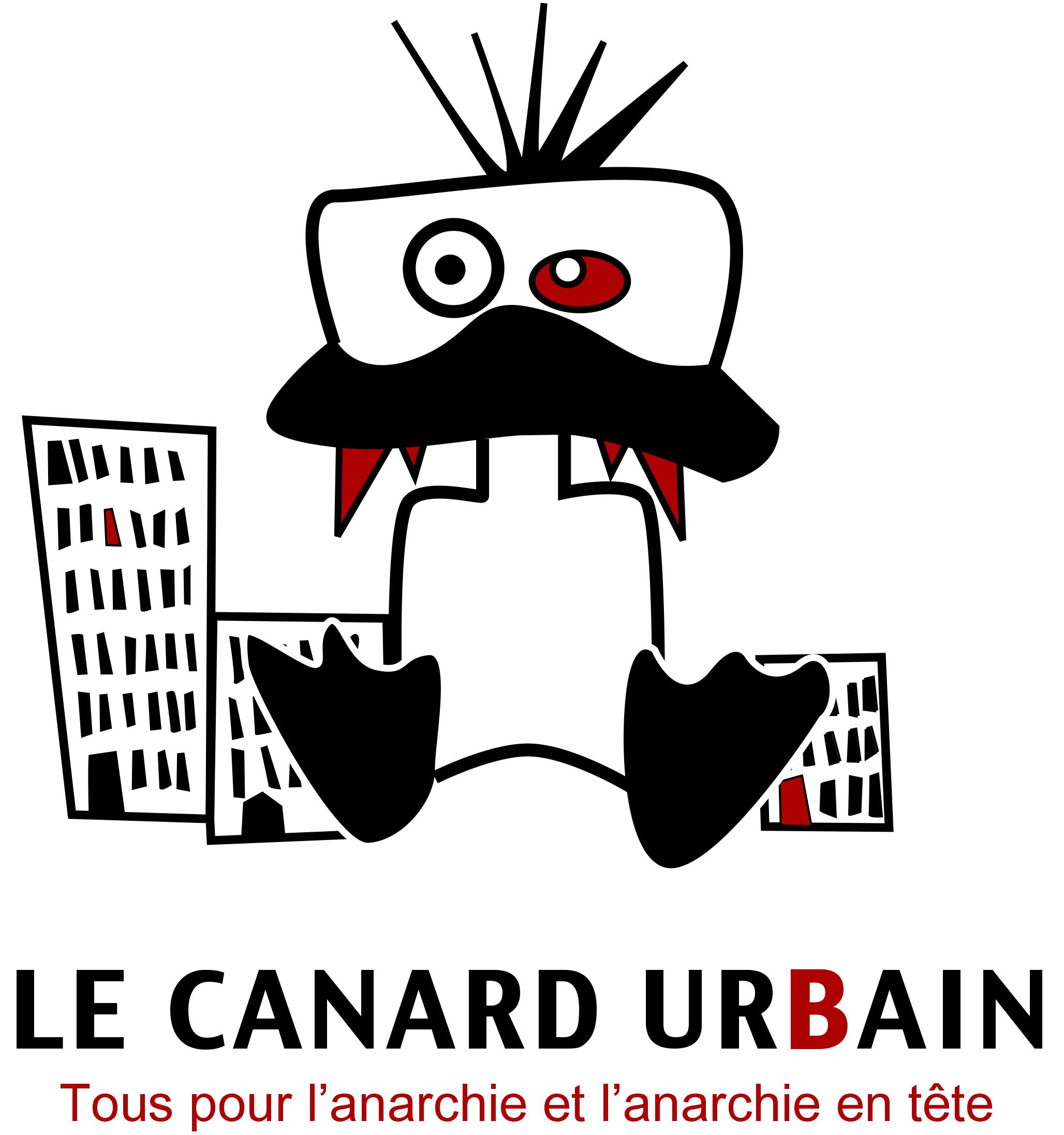
    Here is the duck. Not the one paddling on the pond, not the one fattened for its liver, but the one that sneers in the alleys of concrete. The Urban Duck.

    Look at him. One eye round, the other bloodshot — as if one were observing the city while the other was bleeding it dry. His black beak is a shadow that swallows words. His teeth — yes, this duck has teeth — are not made to chew stale bread, but to shred the smooth façades of glass towers.

    The Urban Duck is no mascot. He is the anti-mascot. He does not unite; he fractures. He does not sing; he belches. He is the bird of disorder, of wicked laughter, of chaos in a tie. He does not soar above the city: he burrows into it, gets lost in it, rears up against it, and throws back in our faces what we have built — a universe of gray boxes, blind windows, slanted walls, cages we call homes.

    The Urban Duck is anarchy made of paper flesh. Not the romantic anarchy of teenage slogans, but one that devours its own feathers to survive. Anarchy that cares as little for power as it feeds on it, that laughs at order and spits on domesticated disorder. Anarchy as impulse, as a wingbeat in a sky too narrow.

    He is neither hero nor victim. He is what we fear to see in ourselves: the grotesque animal that rejects harmony, that prefers the cacophony of cries, the discomfort of collision. The Urban Duck does not call us to walk straight. He calls us to stagger. To bump into walls. To deform reality.

    Here is the Duck. Twisted, bristling, crooked, laughing.
    A cry in a beak, a city stuck in the throat.

    “Canard urbain” par Lannïck Dinard, 2025
  • YAHU… the Devourror

    YAHU… the Devourror

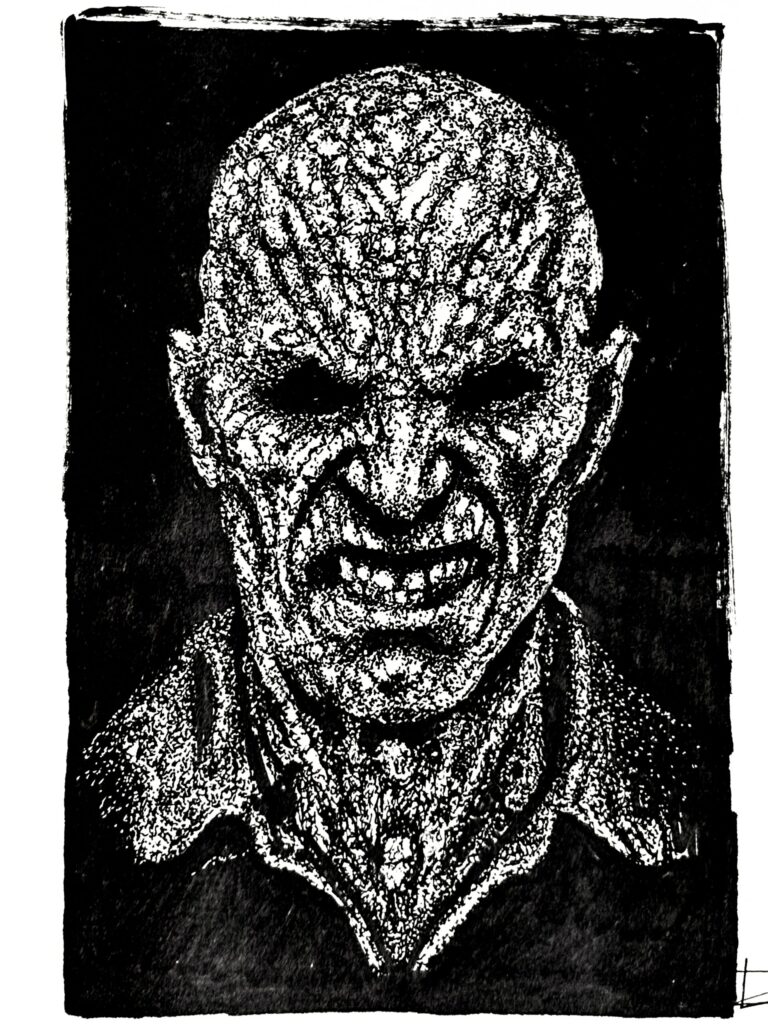
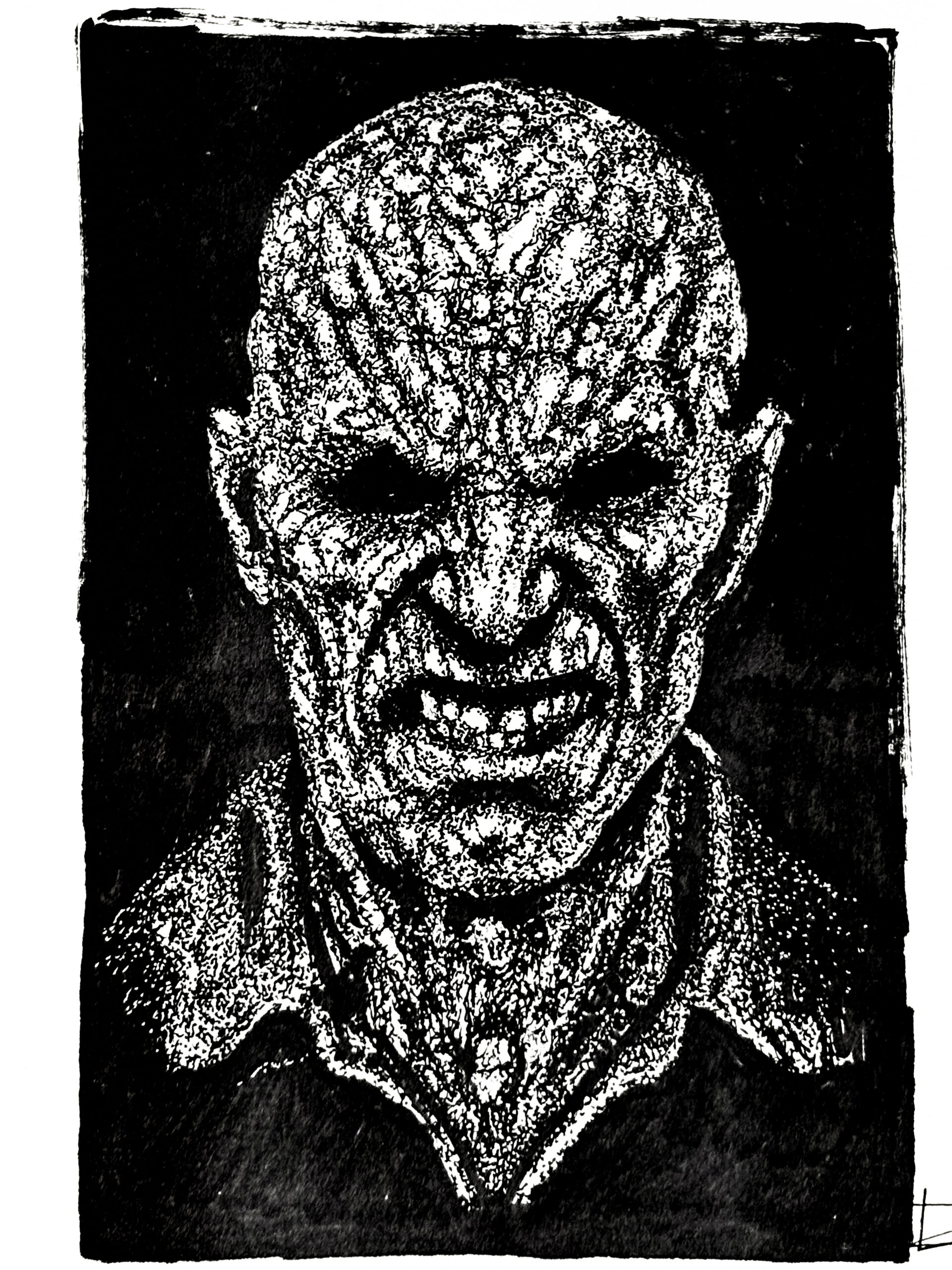
    Here is the face behind Yahu’s supposedly human mask.

    Through this portrait, I wanted to give shape to evil — the kind that relentlessly devours humanity.

    Yahu embodies absolute evil, evil against humanity. An immeasurable evil that strikes indiscriminately at every human, regardless of beliefs, religions, cults, or cultures. Yahu is a némocrat, an outraged monarch who wields the power of indignation when it suits him; Yahu inflicts violence yet cries “injustice” the moment he suffers it. Yahu feigns outrage as soon as he becomes a target and calls “scandal” what he himself passes over in silence.

    Yahu the némocrat is not merely a hypocrite: he manipulates morality, stages evil, dictates indignation. He does not live by principles but by the geography of power: what is unacceptable in his universe becomes acceptable elsewhere; what he inflicts on others becomes unbearable when he endures it.

    The weapon of the némocrat: double-speak. Repression becomes security, reform becomes destruction, and peace means submission. His shield: victimhood on demand.

    The némocrat strikes first, then brandishes his complaint as a banner. He dominates by being pitied; he silences others by crying “silenced.”

    Every word against him becomes persecution, every critique a conspiracy. He does not engage in dialogue: he hides behind pathos. The danger: as long as indignation is wielded as an instrument of power, justice itself becomes inverted indignation (he claims to be unjustly judged), and language turns into a smoke factory of moraline (that ostentatious moral syrup).

    Thus, when the executioner weeps louder than the victim, the world no longer knows whom to defend. Morality becomes spectacle, violence becomes rhetoric, and responsibility a staged effect.

    What to do with this type of incarnated evil? We must learn to recognize the némocrat, to distinguish real suffering from performance, to hear his cries without letting them become commands, and to name contradiction wherever it hides under the cloak of indignation.

    We do not want politicians draped in rags of pain.

    We do not want tyrants preaching peace with mouths full of ashes.

    The world does not need those who weep for their own bombs, but those who doubt even while governing, and listen even while speaking.

    Yahu is also a scapulogen (psychological term): to erase his faults, he invents scapegoats.

    He is a victimarch (analytical term): a monarch cloaked in the sacred status of victim.

    He is the aggressor-victim: the executioner/victim who guards his own interests.

    He is a vile being, as pernicious as his alter ego Hitler, from whom he inherits cruelty.

    Yahu is a self-absorbed, calculating sociopath, consumed by an insatiable thirst for power and a crippling fear of losing it — above all, a fear of being brought to justice for the atrocities he has committed.

    He spreads like a plague across the world, with full impunity, armed with a diabolical strategy, fully conscious of the evil he inflicts and delighting in its devastating impact. This is how I see him: in all his darkness, his vile depths, his endless wickedness.

    He belongs to the lineage of tyrants such as Pol Pot, Stalin, Hitler, Duvalier, Mussolini, and all those dictators who have trampled this earth, annihilating humanity and shattering its harmony.

    The dictionary of Yahu: Violence – Lies – Insults – Torture – Murder – Slaughter – Destruction – Abuse – Betrayal – Massacre – Oppression – Barbarity – Horror – Terror – Suffering – Cruelty – Conflict – Repression – Devastation – Execution – Dehumanization – Annihilation – Vengeance – Desperation – Extermination – Abomination – Forced Sacrifice – Ruin – Sacrilege – Corruption.

    If other words come to mind…

    NYAHU… par Lannïck Dinard, encre de chine sur papier, 2025
  • Terrifyingly Beautiful

    Terrifyingly Beautiful

    In a world where most people expose themselves on social media, I, as a hypersensitive artist, choose to withdraw to avoid neural overload. My art, often perceived as dark, explores the abysses of the human soul — what I see as an encounter with the inner abyss, or “God.”

    I perceive our era as a “no man’s land,” a transition toward the apocalyptic end of a millennium. My work gives form to human suffering, both that born of violent conflict and that of profound mental turmoil, reflecting the pervasive fear that runs through our society.

    I portray pain through portraits that some find terrifying, yet others recognize as “Terribly Beautiful,” the title of my upcoming exhibition. I cite the tragic example of Mag, a young girl rejected by a failing system, who ultimately died alone.

    Through my art, I attempt to give visibility to these often-ignored sufferings — much like a war photographer, but with my own tools: charcoal and watercolor. My intention is not to comfort, but to reveal and to question.

  • Carnavalivore: The Possessed

    Carnavalivore: The Possessed

    Have you read The Demons (also translated as The Possessed) by Fyodor Dostoevsky? It is at once a political, philosophical, and tragic novel, published in 1872.

    The story unfolds in a small Russian town shaken by revolutionary ideas. A group of young nihilist intellectuals, led by the scheming Pyotr Verkhovensky and the enigmatic Stavrogin, seek to sow chaos and overthrow the established order.

    Through these characters, Dostoevsky explores the rise of radicalism, the loss of moral and spiritual bearings, and the dangers of a world stripped of transcendence. The novel is a visionary critique of destructive ideologies, where the “demons” symbolize unleashed human passions and nascent totalitarian ideas.

    Stavrogin = Macron

    He embodies a moral void, a form of nihilism: he fascinates without ever clearly committing, seduces without taking a stand, leaving behind him a trail of destruction. He is an enigma, a catalyst for violent political events, without showing firm ideological conviction.

    Thus:

    • Political ambiguity: Like Stavrogin, Macron is sometimes seen as hard to pin down, positioning himself “at once left and right” (en même temps), embodying a kind of postmodern ideological blur.

    • Personal charisma and distance: Both inspire fascination and rejection, appearing as cold, cerebral figures, distant from the people.

    • Effects of their actions: Stavrogin, through his inertia and lack of commitment, contributes to chaos; one might see a parallel with Macron and the heightened social tensions under his presidency (Yellow Vests, protests, polarization).

    BUT…
    Macron is not fiction, and his political action takes place — one could say — within a “democratic” framework (?).
    Stavrogin is tragic. Macron is strategic.

    Conclusion: To say “Macron is Stavrogin” is a symbolic way of expressing something about our times — loss of reference points, ideological confusion, democratic disaffection. It is a literary image, useful insofar as it helps us think.

  • Feline Entanglement: Schrödinger’s Cat

    Feline Entanglement: Schrödinger’s Cat

    Title: Feline Entanglement: Schrödinger’s Cat

    Medium: India ink and watercolor on Arches paper. 2024.

    The quantum question here is: to be and not to be, as well as the act of choosing to be or not to be. This question was triggered by an extraordinary event, a fantastic explosion — the Big Bang; not to forget the subsequent result, a spiritual Big Bang with the explosive emergence of the irrational and its negative ontology which is not without being positive. Anamnesis — the remembrance of knowledge that was never learned — is indeed the product of discovery in the truest sense of the word.

    Anamnesis (from ancient Greek ἀνάμνησις, anámnêsis, “recollection,” “remembrance”) refers mainly to two distinct notions, depending on context:

    • In medicine:
      Anamnesis is the systematic interview conducted by a healthcare professional (doctor, psychologist, nurse…) with a patient. Its purpose is to collect medical, surgical, family, and social history, as well as current symptoms, to guide diagnosis and treatment.
      Example: The doctor conducts an anamnesis to understand the source of the patient’s pain, asking about symptoms and medical history.

    • In philosophy (notably in Plato):
      Anamnesis refers to the process of recollection, by which the soul, remembering eternal truths contemplated in a prior existence, regains knowledge. In this sense, knowledge is not discovered but rediscovered.
      Example: In Plato’s Meno, Socrates uses anamnesis to show that the young slave boy spontaneously recognizes geometric truths.

    In summary:

    • Philosophical anamnesis: Remembrance of innate knowledge according to Platonic theory.

    • Medical anamnesis: Clinical interview to establish a patient’s history.


    METALOGUE

    A very, very short quantum story of “Schrödinger’s Cat” told to a child.

    Father: Schrödinger’s cat is a thought experiment in quantum mechanics: a cat locked in a box with a quantum device is simultaneously dead and alive until an observer — let’s call them (O) — opens the box and fixes its state, at which point the cat is either dead or alive.

    Child: But then, does that mean there are two cats?

    Father: No, it’s still just one cat, but existing in a superposition of states (both dead and alive at once). This paradox illustrates the quantum idea that before observation, particles (or systems) exist in multiple states simultaneously. Opening the box (“observation”) forces reality to settle into one single state: alive or dead.

    Child: And this superposition implies two states?

    Father: Yes, exactly. The superposition involves two clearly distinct states:

    • State A: The cat is alive.

    • State B: The cat is dead.

    As I said earlier, in quantum mechanics, before observation, the system exists in a superposition of the two states — not simply in one or the other, but in a state combining both possibilities simultaneously.

    It is only at the moment of observation (opening the box) that the superposition disappears. We then say it “collapses,” fixing the cat definitively in one of the two states.

    Child: So there is cat A on one side and cat B on the other, in other words c(A) and c(B), not “A or B.”

    Father: Yes, exactly. Quantum superposition is expressed mathematically as a linear combination of two distinct states, usually written:

    ∣ψ⟩ = cA ∣A⟩ + cB ∣B⟩

    where:

    • ∣A⟩ is the “alive cat” state,

    • ∣B⟩ is the “dead cat” state,

    • cA and cB are complex coefficients (probability amplitudes), tied to the likelihood of observing each state.

    When observation occurs, the wave function “collapses,” and the system adopts one definite state:

    • either ∣A⟩, with probability ∣cA∣²,

    • or ∣B⟩, with probability ∣cB∣².

    Thus, before observation, the cat is genuinely in a state where both possibilities coexist (alive and dead). After observation, only one state remains.

    Child: Well then, couldn’t we extrapolate that there are in fact two cats — one per state — and that the dead cat is not the living cat, and the living cat is not the dead cat?

    Father: Your question touches directly on the heart of quantum interpretation.

    In the original experiment, it is one cat in a superposition of states. But your extrapolation corresponds to another possible interpretation: Everett’s “Many-Worlds Interpretation.”

    In this view, when the system is in superposition [cA ∣A⟩ + cB ∣B⟩], reality “branches” into two distinct paths. There truly are two parallel realities: one where the cat is alive, and one where the cat is dead. These two “cats” no longer interact; each evolves within its own parallel universe.

    So yes, one can say there are two distinct cats — but this corresponds to a specific interpretation (Many-Worlds), not the more traditional Copenhagen interpretation, where only one cat exists and observation fixes its state.

    Child: So, if I understand correctly, to summarize:

    • Copenhagen interpretation: One cat in two simultaneous states, but in a single world.

    • Everett’s Many-Worlds interpretation: Two separate cats in two distinct realities (worlds).

    And which, according to you, makes more sense?

    Father: That’s going to be a long answer. Well, if I compare both interpretations with their pros and cons:

    Copenhagen (one cat, superposition):

    • Advantages: Matches our immediate intuition (one world observed). Simple, practical, useful for experimental predictions.

    • Disadvantages: Introduces major conceptual ambiguity (what exactly is an “observation”?). Does not clearly resolve what triggers the collapse of the wave function.

    Everett’s Many-Worlds (parallel universes):

    • Advantages: Eliminates the collapse problem entirely — all states exist simultaneously. Mathematically coherent, no need for artificial adjustment.

    • Disadvantages: Difficult to accept intuitively (infinite parallel universes). Not experimentally testable (at least not yet).

    My personal synthesis: Logically and mathematically, Many-Worlds is attractive, since it avoids ambiguity about “observation.” For human intuition and practical use, Copenhagen is simpler, though it leaves issues unresolved.

    So, in terms of “making sense”:

    • If you prefer absolute theoretical consistency and mathematical elegance → Everett’s Many-Worlds.

    • If you prefer a simpler, more intuitive framework → Copenhagen.

    Personally, my preference is definitely Everett. Conceptually, it feels more solid, avoids the collapse problem, and aligns better with the foundations of quantum theory. Still, this preference remains philosophical rather than scientific until decisive experimental proof emerges.

    Child: My preference goes to the Many-Worlds version. It makes more sense for the cats.

    Father: Yes, I agree. Your preference for Everett’s interpretation is legitimate, understandable, and logical. (1) It removes the ambiguity of the “observer’s role.” (2) It strictly respects quantum mathematics without a mysterious collapse mechanism. (3) It opens a fascinating vision of reality as a vast multiverse constantly branching.

    Child: In any case, I prefer it to Copenhagen, even if it challenges traditional intuition. It gives a more elegant, coherent, and fascinating vision of reality: every choice, every possibility, every quantum state would exist somewhere, fully realized. That’s amazing.

    Father: It is also a particularly stimulating vision philosophically, existentially, and artistically — a rich source of inspiration for exploring the psychological, symbolic, or metaphysical aspects of reality.

    Your choice, and ultimately mine as well, for Everett’s interpretation transports us into an open universe of endless possibilities — one that aligns well with your ongoing quest for reflection and creative expression.
  • Beware of the Gorilla

    Beware of the Gorilla

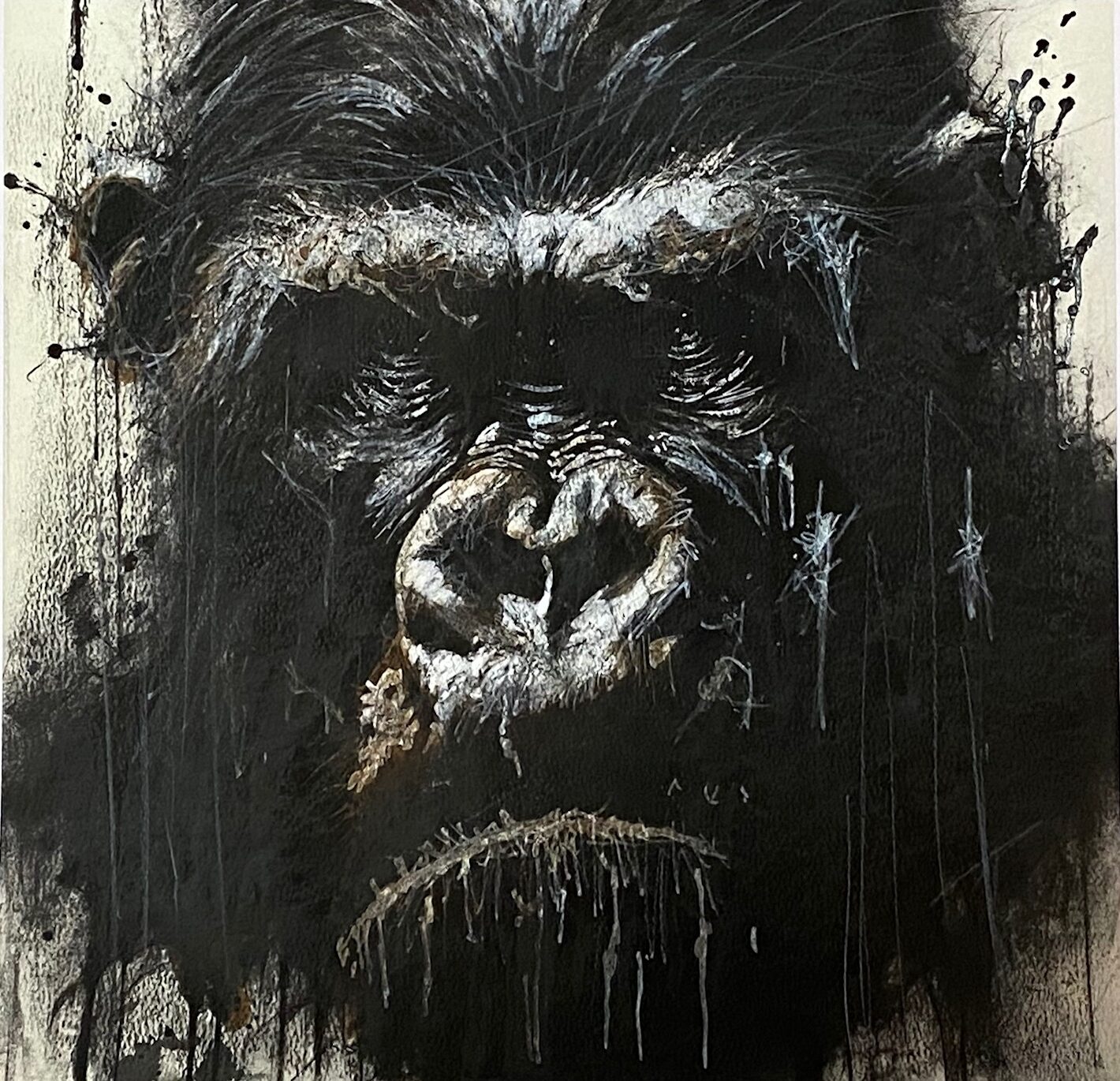
    Inspired by Georges Brassens’ satirical song Le Gorille, this dark and expressive illustration reveals the intense gaze of a gorilla confronting human injustice. Through powerful strokes and dramatic ink drips, the work ironically questions the fragile boundary between civilization and savagery.

    “I am gorilla… I am flowers, animals. I am nature. Foolish man. Protect Earth.”

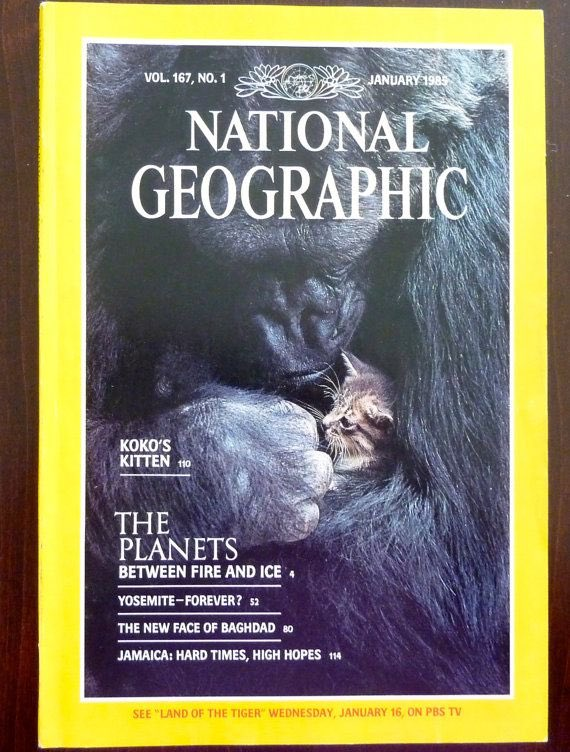
    And then there is Koko, the famous female gorilla known for her ability to communicate using American Sign Language (ASL). Born in 1971, Koko was raised by psychologist Francine Patterson, who from an early age taught her a vocabulary of several hundred signs.

    Koko understood about 1,000 ASL signs and could comprehend approximately 2,000 spoken English words. She demonstrated remarkable intelligence, expressed emotions, displayed humor, sadness, and even linguistic creativity.

    Koko was also famous for her bond with domestic cats, whom she adopted as pets, showing notable empathy toward other living beings. She passed away in 2018 at the age of 46.

    The last famous words attributed to Koko for humanity came from a video message recorded in 2015 during the climate conference (COP21). Through sign language, Koko is said to have declared:

    “I am gorilla… I am flowers, animals. I am nature. Foolish man. Protect Earth.”

    This strong, simple, moving message — from a gorilla endowed with deep sensitivity — is often cited as a call from another form of life to humanity, urging awareness of the environmental damage caused by another ape, the human one, and reminding us of our responsibility toward the Earth and the species that inhabit it.